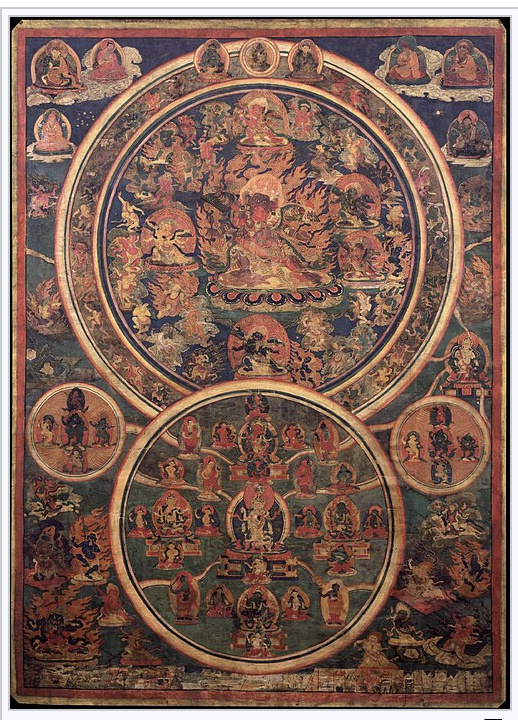
BARDO – In Buddhism—specifically Tibetan Buddhism—bardo means a “gap” or transitional state between two things. While most famous as the 49-day intermediate state of consciousness between death and rebirth (detailed in texts like the Tibetan Book of the Dead), it also broadly describes any liminal or in-between phase of existence, such as dreaming or deep meditation.
The Six Traditional Bardos – Tibetan traditions outline six distinct transitional states that encompass everyday life, death, and spiritual practice:
- Natural Bardo of This Life: The period from birth until the onset of death.
- Bardo of Dream: The dream state experienced during sleep.
- Bardo of Meditation: The focused state experienced during deep contemplative practice.
- Bardo of Dying: The final process of bodily dissolution as life ends.
- Bardo of Dharmata: The luminous, pure experience of reality after the final breath.
- Bardo of Becoming: The transitional phase where consciousness moves toward a new rebirth.
I am depressed and in my Bardo. My life of work, caring for Mom, and my “next life.” I am old. That is true. However, age can be attacked or embraced; respected. Maybe there isn’t much for me to do in this Bardo. I can acknowledge my depression and learn from the shadows.
In-between-lives. Can I remain open; kind; accepting; curious? Can I stay in position to ask… God for help? Yet, through some Power much greater than me, I hold on.
How can I ever accept my Bardo in a state of self-obsession? How can I step into a new life when I am cemented to the past?
“It seems that growing up, aging, maturing, is bad. It is synonymous with a used-up, dissatisfied life. Today it seems that everything hides behind makeup and a mask. As if the very fact of living did not make sense. How sorrowful it is that someone would want to erase the wrinkles of the many encounters, the many joys and sorrows!
But our society discards both the one and the other, it discards the young as well as the old. Yet the salvation of the old is to pass memory on to the young, which makes the old true dreamers of the future; whereas the salvation of the young is to accept these teachings, these dreams, and carry them into the future, like prophets. In order for our young people to have visions, to be dreamers themselves, and to be able to face the future boldly and courageously, they must listen to the prophetic dreams of their forefathers. Old dreamers and young prophets are our uprooted society’s path to salvation: Two generations of discarded throwaways can save us all.”
Pope Francis
 Faith & Roses
Leave a comment